
The Last Click Is Lying to You: Why Google Search Got Expensive, AI Got Greedy, and Audiences Got Smarter
What if the single metric your team trusts most — the last click before a sale — is quietly steering your budget into your least efficient channel?
Here's a scenario every marketing director will recognize. You pour budget into paid search because the dashboard says it "drives" 60% of your conversions. Costs climb, so you bid higher to defend position. The dashboard rewards you with more last-click credit, so you double down again. Eighteen months later, your cost per acquisition is up, your pipeline of genuinely new prospects is thinning, and nobody can quite explain why. As a data analyst, I see this loop constantly — and the data now tells us exactly where it breaks.
Google Search Got Expensive — and It's Structural, Not Seasonal
Paid search isn't having a bad quarter. It's in a multi-year cost climb.
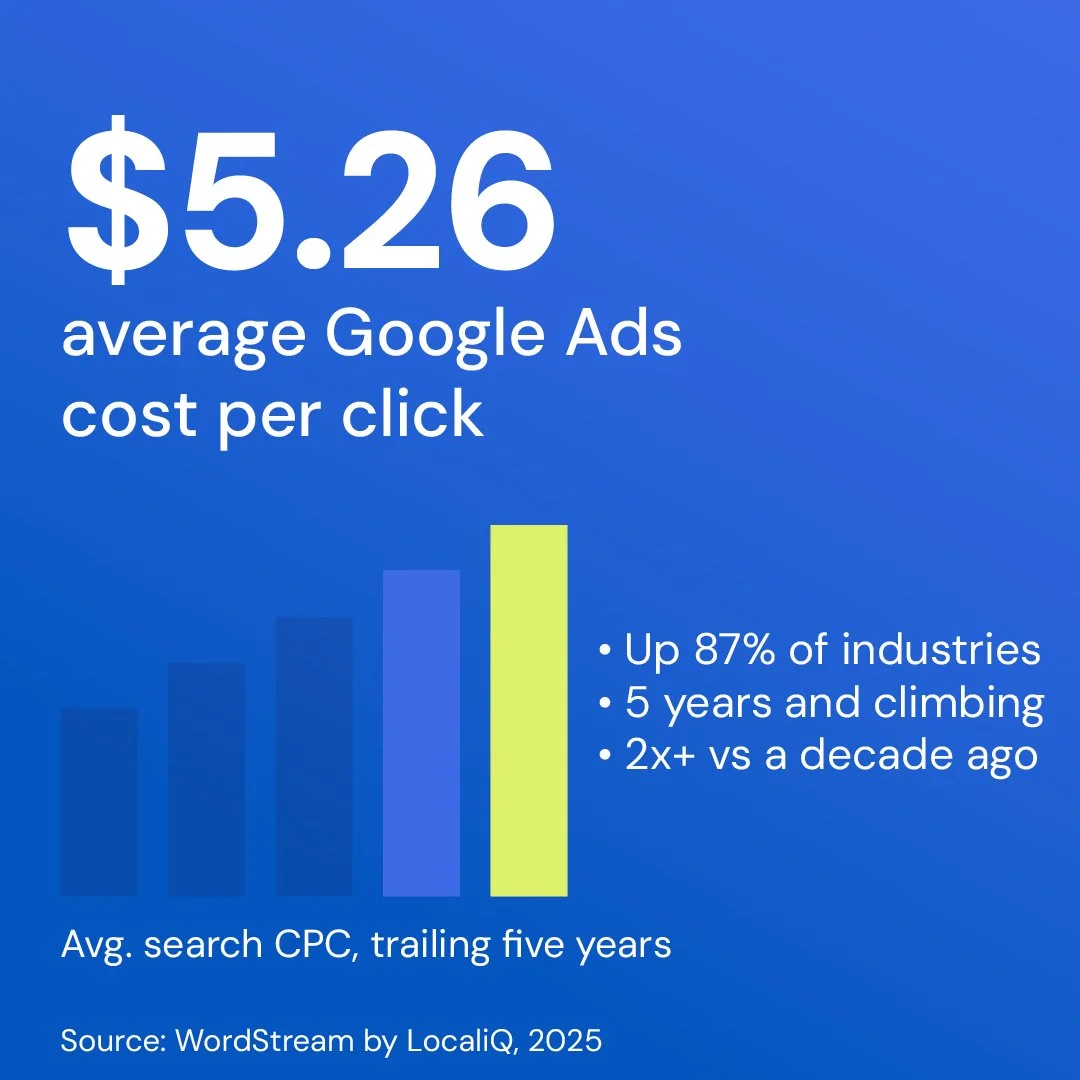
Paid search isn't having a bad quarter. It's in a multi-year cost climb. According to WordStream by LocaliQ's 2025 benchmark report — built on more than 16,000 campaigns running from April 2024 through March 2025 — the average Google Ads cost per click reached $5.26, up roughly 13% year over year, with CPC rising for 87% of all industries tracked. That's not a blip: it caps five straight years of rising search costs, and average CPC is now more than double what it was a decade ago. As Search Engine Land summarized it, cheap traffic is disappearing.
If you sell into the verticals USADATA serves, the pain is sharper than the average suggests. WordStream's benchmark places the priciest clicks in exactly these categories:
Attorneys & Legal Services — ~$8.58 per click
Dentists & Dental Services — ~$7.85
Home & Home Improvement — ~$7.85
Education & Instruction — ~$6.23
Finance & Insurance — high competition pushing costs up across the board
Why? These industries combine high-intent keywords with high customer lifetime value, which invites aggressive, well-funded bidding. The mechanics are simple: the supply of high-intent search inventory is fixed, demand keeps rising, and price follows.
The nuance worth holding onto comes from LocaliQ's Cliff Sizemore, who noted that while costs are up, performance improved for most advertisers — "a smart strategy beats cheap clicks." Translation: the answer to rising CPCs isn't to chase the cheapest click. It's to stop letting one channel take all the credit.
AI Search Is Eating the Clicks You're Paying to Compete For
The bigger structural shift is happening above the ad auction. Google is increasingly answering the question on the results page itself.
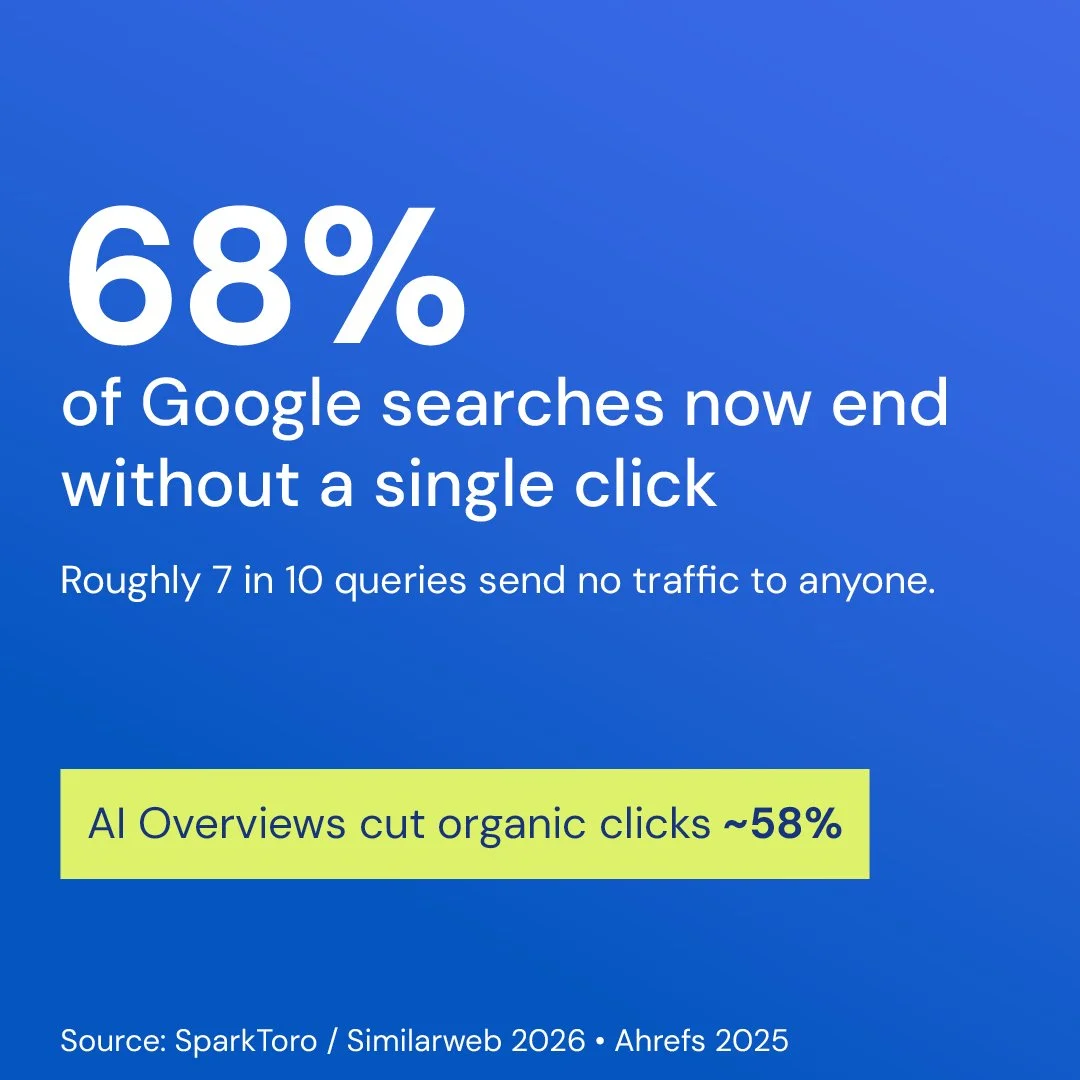
The numbers are stark. SparkToro's analysis of Similarweb clickstream data found that in the first months of 2026, roughly 68% of Google searches ended without any click at all — up from about 60% in 2024, the fastest acceleration of "zero-click" behavior in a decade. The catalyst is AI Overviews, which, when present, cut organic click-through rate by nearly 58%, according to Ahrefs' December 2025 study.
It gets more pointed for anyone relying on organic discovery. Pew Research found that users click a link inside an AI summary only about 1% of the time, and that the presence of an AI summary roughly halves clicks to traditional results (8% vs. 15%). Meanwhile, Bain & Company's research reported that 80% of consumers now rely on AI-generated answers for at least 40% of their searches, with organic web traffic down an estimated 15–25% across many sectors.
Put the two trends together and the picture is clear: the clicks coming out of Google search are getting both more expensive to buy and scarcer to earn. If your acquisition model assumes a steady supply of cheap, attributable search clicks, the ground is shifting under it.
The Golden Age of Last-Click Attribution Is Over
Here's the uncomfortable part. Last-click attribution — the model baked into Google Analytics, most ad platforms, and most CRMs — gives 100% of the credit to the final touch before conversion. It was never accurate; it was just easy. And in a fragmented, AI-mediated journey, "easy" has become "actively misleading."
Today's buyers don't convert in one interaction. Google has cited journeys spanning 20+ touchpoints across devices, channels, and weeks before a purchase. Last-click sees only the final domino and credits it with the whole sequence. As attribution analysts at Trackingplan put it, last-click systematically overvalues bottom-funnel tactics like branded search and retargeting — which merely capture demand created elsewhere — while undervaluing the awareness and consideration channels that started the journey. When teams switch to multi-touch or data-driven models, those upper-funnel channels typically turn out to drive 40–60% more value than last-click reported.
The cost of believing the last click is real money: budget pulled out of the channels that create buyers and poured into the channels that merely close them. The lesson for 2026: if you measure success only by the last click, you are reading the map from the previous war.
The Solution: Spend on Demand You Create, Not Just Demand You Capture
The advertisers protecting their returns aren't the ones spending the most on search. They're the ones rebalancing toward three things the last click can't see: omnichannel reach, brand building, and owned/custom audiences. The data backs all three.
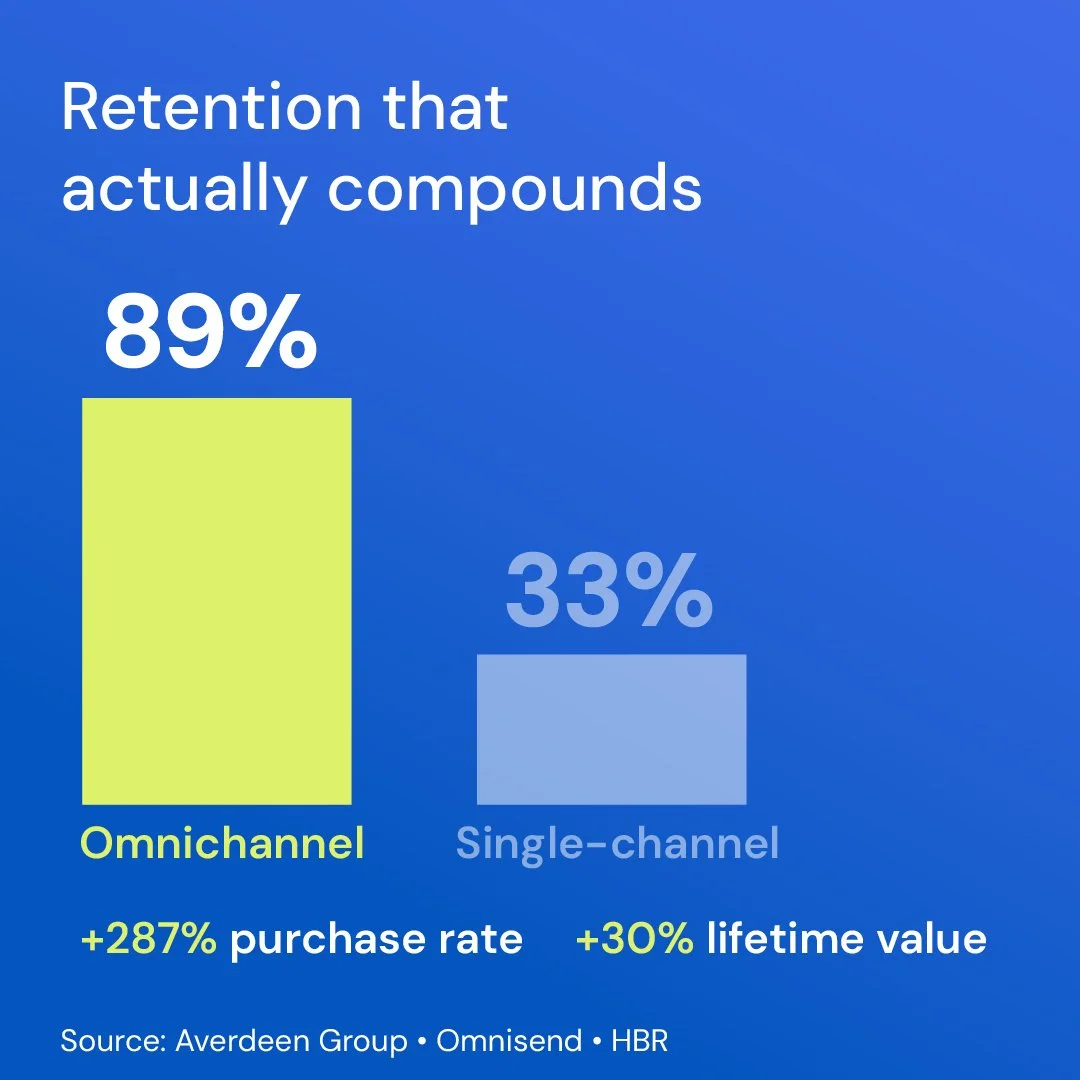
Omnichannel beats single-channel on the metrics that compound.Omnisend's analysis of 135,000+ campaigns found that campaigns using three or more channels saw a 287% higher purchase rate than single-channel campaigns. Aberdeen Group data shows companies with strong omnichannel engagement retain roughly 89% of customers, versus 33% for weak efforts — and grow annual revenue 9.5% versus 3.4%. A landmark Harvard Business Review study of 46,000 shoppers found omnichannel customers carry about 30% higher lifetime value than single-channel buyers.
Brand building isn't a luxury — it's the efficiency engine. Les Binet and Peter Field's analysis of 996 IPA case studies produced the now-famous 60/40 guideline: roughly 60% of spend to long-term brand building, 40% to short-term activation. As Binet told Marketing Week, "60% of the payback comes from long-term brand."WARC's Multiplier research found that shifting from performance-only to a blended brand-plus-performance mix lifted ROI by around 90%. Brands that push past 70% activation see short-term gains and long-term decline — the exact loop described at the top of this article.
Custom, first-party-style audiences deliver the durable ROI search can't. A Google/Boston Consulting Group studyfound that marketers using first-party data for key marketing functions achieved up to a 2.9x revenue uplift and a 1.5x increase in cost savings versus those that didn't. And modeling lookalike audiences on your highest-LTV customers — rather than bidding against everyone for the same keyword — has been shown by McKinsey to improve return on ad spend by roughly 40%. The principle is simple: focus spend on the people most likely to become valuable, repeat buyers.
Five Moves to Trade Click Dependence for Durable ROI
Re-baseline your attribution. Adopt a multi-touch or data-driven model before you touch budgets. You can't reallocate spend intelligently while last-click is grading the exam.
Cap your activation share. If more than ~70% of your budget is chasing bottom-funnel clicks, you're starving the demand engine. Shift toward the 60/40 principle, flexed for your category and brand maturity.
Build audiences from your best customers, not your cheapest keywords. Use modeled, lookalike, and intent-layered segments seeded on high-LTV profiles to reach the right people across channels.
Go omnichannel on purpose. Coordinate display, email, paid social, and online video around one consistent story so each touch reinforces the last — that's where the 287% purchase-rate and 30%-higher-LTV numbers come from.
Measure LTV and retention, not just CPC and CTR. The metrics that survive the AI search era are those tied to the lifetime value of the customers you acquire.
The USADATA Advantage
This is the gap USADATA was built to close. Our proprietary big-data infrastructure turns "spend on demand you create" from a slogan into an executable plan:
Personicx® segmentation and Lifestages let you build precise, modeled audiences around your most valuable customer profiles — the high-LTV seed every efficient acquisition program needs.
Intent data layering and trigger audiences (including new-mover and life-event signals) put your message in front of in-market prospects before they ever run the expensive branded search you'd otherwise pay a premium to win.
Omnichannel activation across display, email, paid social, and online video delivers the coordinated, multi-touch reach that drives the retention and lifetime-value gains the benchmarks describe.
Self-serve audience counts and list ordering mean you can size a custom audience in minutes, not weeks — and shift budget toward people, not keyword auctions.
The takeaway for any data analyst staring at a rising-CPC dashboard: Google search will keep getting more expensive and AI will keep absorbing the clicks. The brands that win the next few years are the ones that stop renting demand by the click and start owning the audience.
Ready to see what a custom, high-LTV audience looks like for your business? Request a free audience count at usadata.com or call us at 800-399-8611.
Sources & Further Reading
WordStream / LocaliQ — 2025 Google Ads Benchmarks (avg. CPC $5.26; 87% of industries rising; vertical CPCs; Sizemore quote)
SparkToro — Less Than One Third of Google Searches Still Send a Click (2026)
Ahrefs — AI Overviews Reduce Clicks by 58% (December 2025 update)
Pew Research Center — Google Users Are Less Likely to Click When an AI Summary Appears
Trackingplan — Optimizing Attribution Tracking (last-click over/undervaluation; 40–60% upper-funnel value)
Omnisend — Omnichannel Marketing Statistics (287% higher purchase rate)
Aberdeen Group data via Porch Group Media (89% vs 33% retention; 9.5% vs 3.4% revenue)
Harvard Business Review — A Study of 46,000 Shoppers Shows That Omnichannel Retailing Works (30% higher LTV)
Marketing Week — Les Binet on brand vs performance (60/40; "60% of the payback")
WARC Multiplier Effect summary — 60/40 brand/performance ROI (~90% ROI uplift from blended mix)
Think with Google / BCG — Sustainable First-Party Data Strategy (2.9x revenue uplift; 1.5x cost savings)

